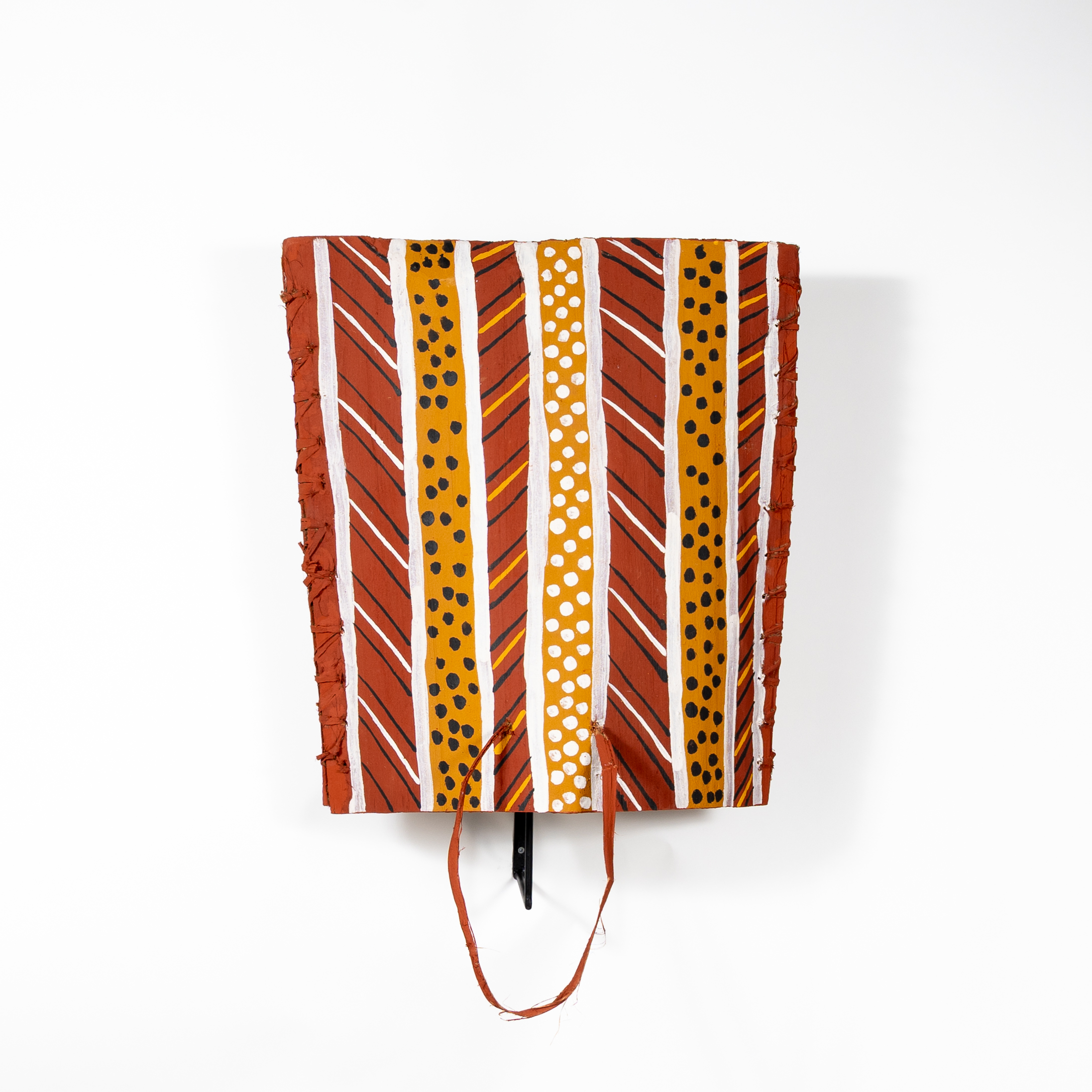
Brooks is a young Tiwi artist, arts worker and governance leader at Jilamara Arts in Milikapiti. As an emerging artist, his practice has already reached significant national platforms. In 2025 he presented a body of tunga as part of the Rigg Design Prize at the National Gallery of Victoria, placing his work within one of Australia’s most prestigious design contexts and introducing his practice to a national design and collecting audience. In 2026 he was named a first-time finalist in the 3D award category of the Telstra National Aboriginal and Torres Strait Islander Art Award
(NATSIAA) at Museum and Art Gallery of the Northern Territory, Darwin.Central to Brooks’ development as an artist is the intergenerational environment at Jilamara Arts. He works under the broader guidance of senior carver Patrick Freddy Puruntatameri in the open-air Murrunungumirri workshop, learning and refining the protocols of carving, curing, and painting that have been passed down through generations of Tiwi artists and cultural knowledge holders. Alongside his own studio practice, Brooks collects and prepares materials for other artists at the centre. He leads the seasonal bark-harvesting team and helps senior artists teach culture to local primary and high school students through the Culture Class program. He has served on the Executive Committee of Jilamara Arts and Crafts Association, acting as a voice for its younger membership, and his broader practice — including performing Tiwi Yoyi (dance) at the Art Gallery of South Australia for Tarnanthi and as part of the collaborative multi-media artwork YOYI (dance) — a four channel projection artwork that showed at the University of Melbourne, Gropius Bau (Berlin) and The National 4: Australian Art Now at MCA Australia. Wangatunga Jirtaka Jilamara is a work that carries this narrative of Wally’s development as an artist, artsworker and emerging governance leader. Entry into the Morgans National Emerging Art Prize offers Brooks the opportunity to bring this work, and the practice behind it, to a broader Australian audience.