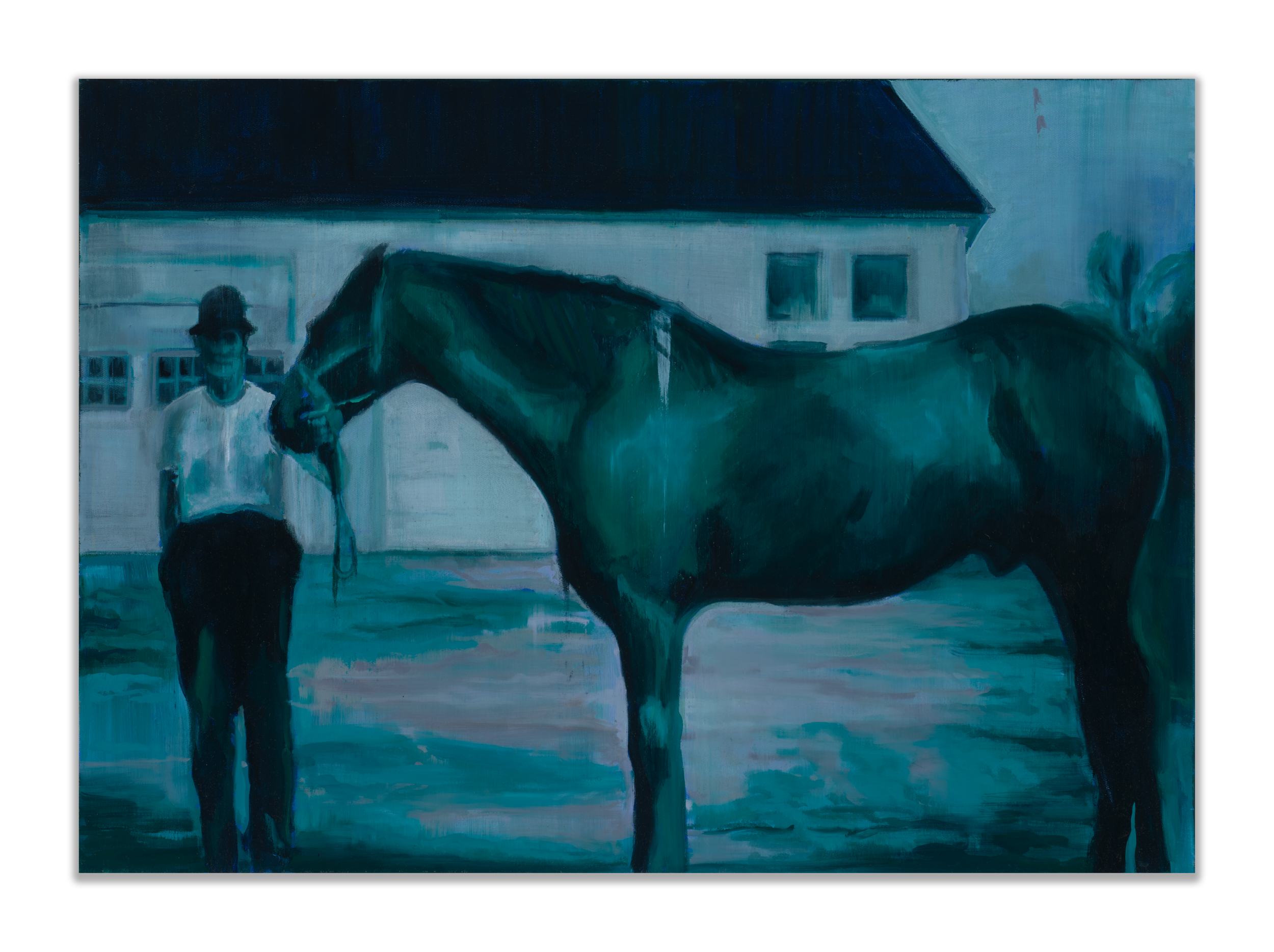
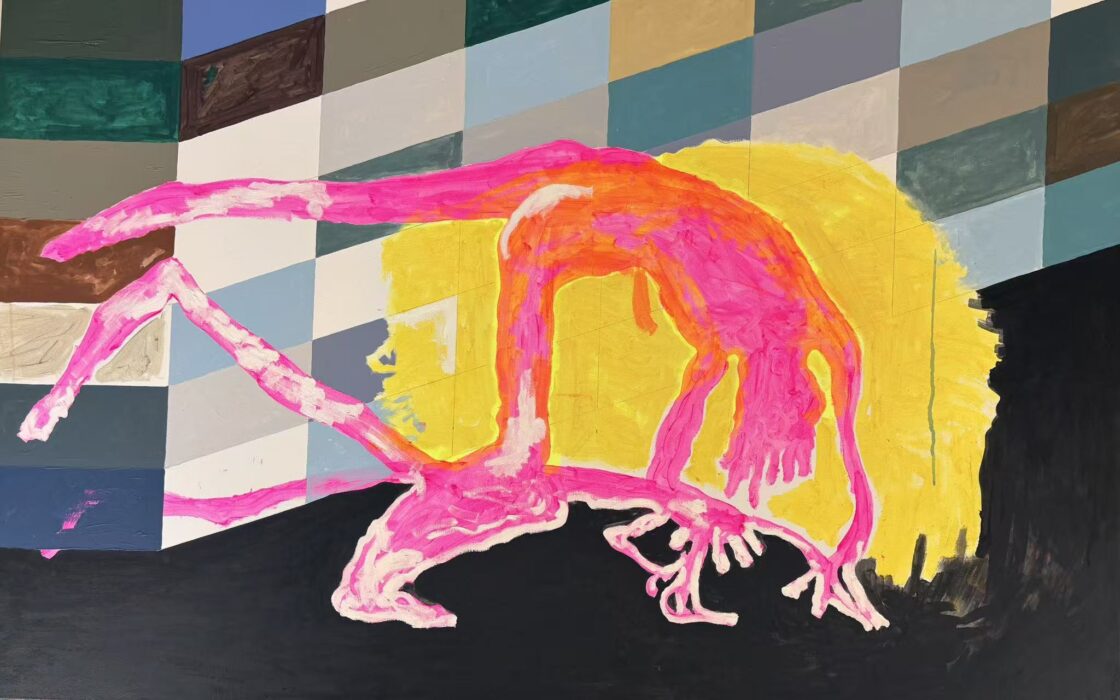
Green Horse explores the psychological and emotional dimensions of rural Australia through
themes of memory, isolation, and hauntology. Depicting a lone figure beside a horse within a
subdued rural landscape, the work reflects my ongoing interest in how the Australian bush
carries emotional residue and unresolved histories. Central to this work is an engagement with hauntology: the idea that the past is never fully gone but instead lingers within the present as an unresolved presence. Originally conceived by philosopher Jacques Derrida and later expanded in cultural theory, hauntology describes the way certain histories and experiences refuse to disappear, they persist as traces, returning to unsettle the present rather than remaining comfortably in the past. In the context of rural Australia, this speaks to the grief of failing farms, the silence of abandoned communities, and the weight of colonial histories that continue to shape how land is occupied, understood, and felt. Through a muted palette, softened forms, and atmospheric ambiguity, the painting suggests something remembered rather than directly observed. The figure and horse appear familiar yet emotionally distant, evoking a lingering sense of absence and psychological
tension.
Rufus Punton explores the psychological and emotional dimensions of rural Australia through themes of memory, isolation, precarity, spectrality and hauntology. Drawing from his upbringing in regional Victoria and a family shaped by rural labour and economic uncertainty, Punton considers how economic instability, climate uncertainty, and social change become embedded within people and places, leaving traces that persist across generations.
Punton approaches the rural environment not simply as a physical location, but as a psychological space shaped by memory and histories that continue to inhabit the present. Working from archival, vernacular, and contemporary imagery, he reconstructs scenes of rural life that appear familiar yet emotionally distant. Figures, animals, landscapes, and domestic spaces become fragments through which histories of labour, community, loss, and social change are reconsidered.
Rather than treating photography as an objective record of the past, Punton transforms photographic source material through processes of blurring, distortion, scraping, tonal reduction, and painterly ambiguity. These interventions shift the work beyond documentary representation, allowing the paintings to explore the emotional residue and unresolved experiences that photographs cannot fully contain.
Central to Punton’s work is an engagement with hauntology, where the past persists as an unresolved presence within the contemporary rural landscape. His paintings consider how histories persist through changing environments, abandoned communities, family memory, and the remnants of lives shaped by economic and social precarity. This extends to the broader histories embedded within the Australian landscape, including the enduring presence of colonial histories and their influence on how land is occupied, remembered, and understood.