Djimiyapin Gumana

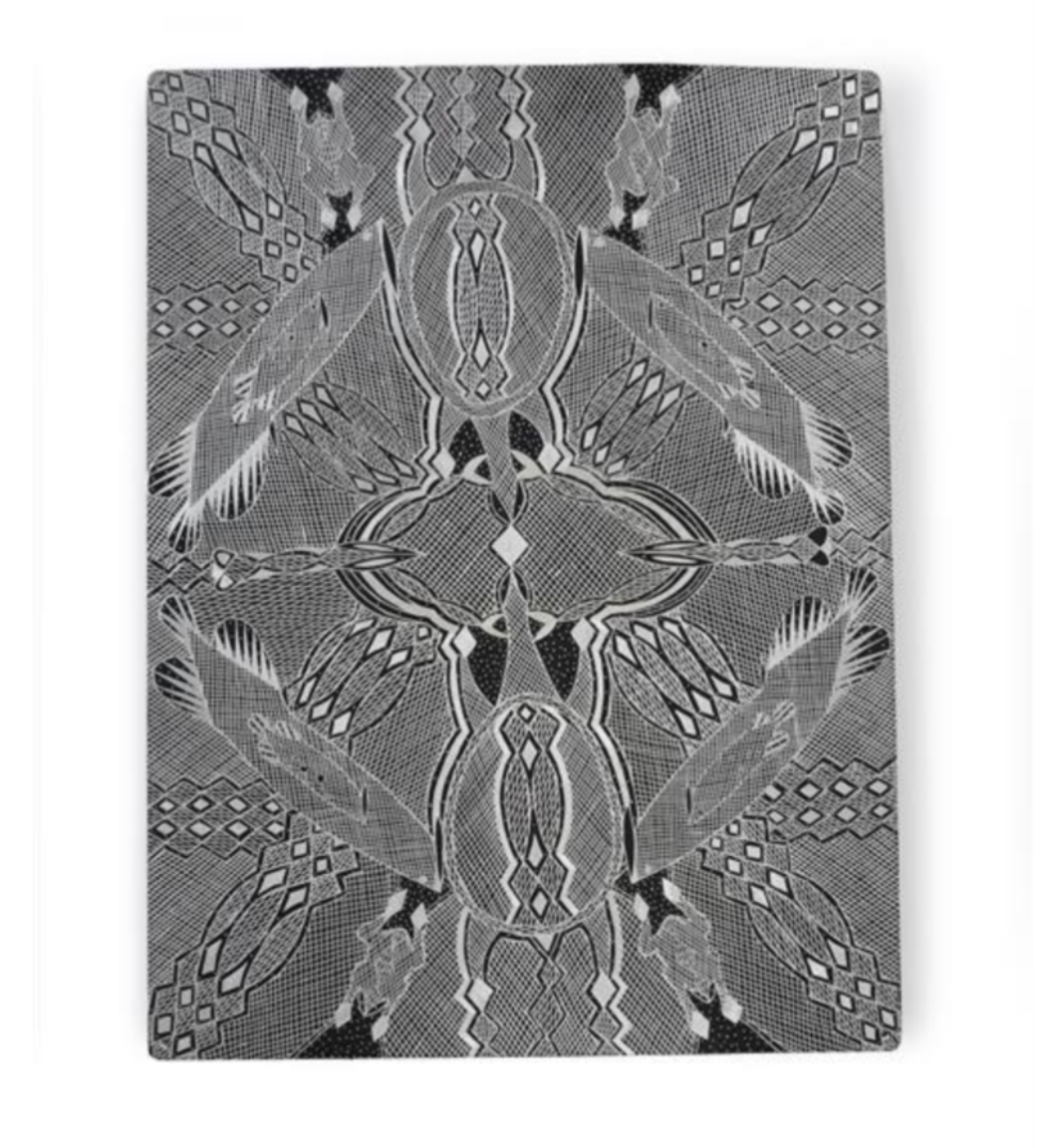
Gangan Baraltja Burrut’tji Barama, 2026

ETCHED ALUMINIUM
80 × 60 cm
$2,600
Barama the Ancestral Creator Being directed the insgaon of lore for the Yirritja. It is said that during the mes of Waŋarr, the period of the first mornings, aer travelling from the coast of Blue Mud Bay, he emerged from a freshwater billabong at Gäṉgaṉ. Barama carried a sacred staff symbolic of deep seated knowledge and with weed hanging from his arms and water steaming from his body he strode ashore. Here at Gäṉgaṉ he was met with others, his disciples and inial ceremony was performed for the Yirritja moiety – given to the Dhalwaŋu. From here the Creator Beings travelled to what was to become Yirritja land, giving law, language, song, dance, totems and madayin (restricted business) to the Yolŋu. This painng has reference to these inial events as it depicts he sacred waters of Gäṉgaṉ and Dhalwaŋu totems that witnessed the first coming. The diamond fields is of the water at Gäṉgaṉ and the immediate region, the design manifests the rivulets of the same as they shed from Barama’s body. Wurran the diver duck dries its wings and travels the Gäṉgaṉ waterways from the coast up inland past Gäṉgaṉ to more water at Gapuwiyak. Baypiṉŋa the saratoga stays within the boundary of freshwater so is also found at the sacred areas of Gapuwiyak (not Lake Evella). Dhakawa ancestral freshwater cray keeps the font under the freshwater at Gangan clear from obstrucon. The water is muddied/contaminated/sancfied from this point on. Every season, the systems that feed the mangrove creek of Baraltja (home of Burrut’tji, the Lightning Snake) bring in the new season freshwaters. One source is from the Dhalwaŋu clan estates of Gäṉgaṉ depicted by this diamond design. As it does Burrut’tji ‘tastes” the first freshwater coming down. At this the Lightning Snake at its residence stands on its tail and spits lightning into the storm. Incoming waters flood first the plains then the mangrove lined creeks that finally empty into the sea. Leaves of the mangroves fallen into the water bank up on the surface in fields of red, yellow and black known as Motu. The serpent has been depicted sping lightning. This acon shows communicaon between the different lightning snakes of different Yirritja clans located hundreds of miles away which is seen in the lightning. They are located to the East and south West and this is why the snakes indicate direcon in a mirrored way. In ancestral mes, Burrut’tji travelled underground to Gäṉgaṉ (homeland of the Dhaḻwaŋu people) and other places far away from his home and into country belonging to other clans including the Maŋgalili. The spine of the snake is important as it was laid underwater as part of a fish trap made by ancestral Yirritja. It is the ancestral remains of this trap that cause a natural barrage across the dal creek leading out of Baraltja that concentrates the flow concerned from the plain banking up the motu (fallen mangrove leaves) at this site. The water rat is a colleague and food source of Mundukul. In mortuary ceremonies held for Yolŋu in the past, a hollow log was used to contain the bones of the deceased. Burrut’tji is closely associated with the hollow log in mortuary ceremonies. Burrut’tji and his home are most sacred aspects of the ceremony which would be conducted only by elder men. Women would not be able to enter the area of the ceremonial ground used to represent Burrut’tji’s home – the journey of the spirit of the deceased Maḏarrpa person begins from this site. In the less restricted secons of this story, both men and women dance the fish, birds, mangrove leaves, fish trap, dogs, de lines and other elements and tell the same story through song and dance. In summary, the diamond based field which includes an ellipcal shape is the muddied freshwater of the boom Dhalwaŋu clan downstream from Gangan. The concepon that this flows out through Baraltja (a small mangrove creek in a different watercouse) is actually technically possible at the me of Wet Season inundaon of the floodplains behind the mangroves where an expanse of water up to 50km long can exist connecng the two. But the real connecon being mapped is that between the Dhalwangu and their mother’s mothers- the Madarrpa. The arst said that Burrut’tji has a place at Gangan and this site mirrors the one at Baraltja, side by side.

Djimiyapin Gumana is a contemporary Indigenous Australian artist and maker from Arnhem Land in the Northern Territory.
Part of the Dhaḻwaŋu clan based in the freshwater homeland of Gäṉgaṉ. He is the son of the respected leader Dhäkuwal Gumana and was traditionally instructed in cultural practices and artistic training by his legendary uncle, Dr. Gawirriṉ Gumana AO.
He creates and distributes his work through the highly acclaimed, Indigenous-controlled Buku-Larrŋgay Mulka Centre located in Yirrkala.
National Emerging Art Prize